
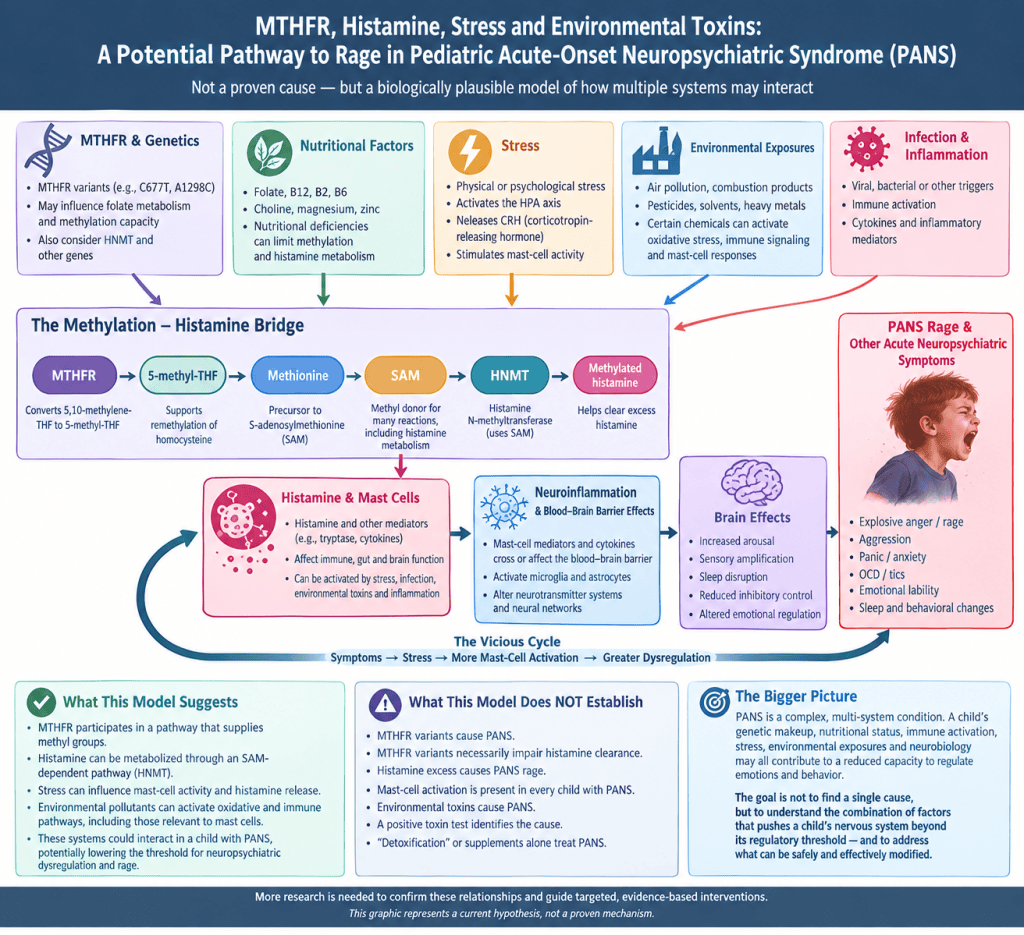
A hypothesis linking methylation, mast-cell activation, neuroinflammation and emotional dysregulation
Few symptoms associated with pediatric acute-onset neuropsychiatric illness are as frightening and confusing for families as sudden, extreme rage.
A child who was previously affectionate, flexible and emotionally recognizable may abruptly begin having explosive episodes, intense irritability, aggression, panic, sensory intolerance or seemingly uncontrollable emotional reactions. The episodes may occur alongside obsessive-compulsive symptoms, tics, restrictive eating, urinary symptoms, sleep disturbance, separation anxiety or other abrupt behavioral changes.
This pattern can occur in Pediatric Acute-Onset Neuropsychiatric Syndrome (PANS), a clinical syndrome characterized by the sudden onset of obsessive-compulsive symptoms or restrictive eating together with other acute neuropsychiatric manifestations. Current PANS guidance emphasizes that evaluation should consider infectious, inflammatory, neurological, psychiatric and other medical contributors.
But what might explain the extraordinary intensity of the emotional symptoms?
One potentially useful—although still unproven—framework is to examine the interaction among:
MTHFR and one-carbon metabolism → methylation capacity → histamine metabolism → stress and mast-cell activation → environmental inflammatory signals → neuroinflammation → impaired emotional regulation
This framework does not establish that MTHFR variants, histamine excess or environmental toxins cause PANS.
Rather, it offers a biological hypothesis for why some children might have a lower threshold for neuropsychiatric dysregulation when infection, immune activation or other physiological stressors occur.
Rage may be a symptom of nervous-system overload
The word “rage” can unintentionally make a neurological phenomenon sound purely behavioral.
Parents may describe episodes in which their child:
- becomes explosively angry with little apparent provocation;
- screams, hits, kicks or throws objects;
- becomes intensely oppositional;
- appears terrified or overwhelmed;
- cannot tolerate ordinary sensory stimulation;
- seems unable to stop once an episode begins;
- rapidly shifts between rage, panic and crying;
- has dramatic sleep disruption;
- subsequently appears exhausted or remorseful; or
- later has little understanding of why the reaction was so extreme.
In a child with abrupt neuropsychiatric symptoms, this deserves more than a simple behavioral explanation.
PANS treatment recommendations recognize the importance of simultaneously addressing psychiatric/behavioral symptoms and possible underlying infectious or inflammatory processes.
One possibility is that rage represents a failure of regulatory capacity rather than a primary desire to behave aggressively.
The child may be experiencing a state of extreme neurological arousal in which the systems responsible for inhibition, emotional regulation and flexible thinking are temporarily overwhelmed.
This raises a critical question:
What biological factors could push a child’s nervous system toward that state?
Histamine and mast-cell biology provide one possible link.
Histamine is more than an allergy chemical
Histamine is commonly associated with allergies: itching, hives, nasal symptoms, gastrointestinal reactions and asthma.
But histamine is also a neuroactive signaling molecule.
Histamine participates in communication within the central nervous system and influences arousal, sleep-wake regulation, cognition, autonomic activity and immune signaling.
Mast cells are another important part of this system.
These immune cells contain histamine and numerous other inflammatory mediators. When activated, mast cells can release histamine, proteases, cytokines and other signaling molecules. Mast cells can therefore participate in both acute allergic responses and broader inflammatory processes.
This creates a potential connection between immune activation and neurological symptoms.
The important question is not simply:
“Does this child have allergies?”
It is:
“Could excessive or poorly regulated histamine and mast-cell signaling contribute to a state of heightened neuroimmune arousal?”
That question is still being investigated.
Stress can activate the mast-cell system
The connection between stress and mast cells is particularly interesting.
Psychological and physiological stress activate the hypothalamic-pituitary-adrenal (HPA) axis. Corticotropin-releasing hormone (CRH), a central component of the stress response, interacts with immune pathways, including mast cells.
Experimental and review literature describes neuroimmune connections in which acute and chronic stress can influence mast-cell activity and the release of mediators including histamine and tryptase.
This provides a possible biological feedback loop:
stress
↓
CRH / sympathetic activation
↓
mast-cell activation
↓
histamine + inflammatory mediators
↓
greater physiological arousal
↓
greater sensitivity to stress
The result can become a self-reinforcing cycle.
A child does not need to be consciously “stressed” for this system to be activated.
Pain, infection, sleep deprivation, sensory overload, inflammation and fear can all represent physiological stressors.
The stress-histamine-rage connection
Consider what happens when a child’s nervous system is already inflamed or sensitized.
The child may begin the day with a reduced regulatory reserve.
Then several things happen:
poor sleep
↓
increased stress response
↓
increased sensory sensitivity
↓
greater autonomic arousal
↓
histamine/mast-cell signaling
↓
increased inflammatory signaling
↓
lower threshold for emotional dysregulation
↓
rage
The behavioral episode may therefore be the final visible expression of a much larger physiological process.
This is particularly interesting in PANS because the syndrome itself involves an abrupt change in neuropsychiatric function, often occurring in temporal association with infection or other inflammatory processes.
The PANS/PANDAS Research Consortium specifically discusses neuroinflammation and post-infectious autoimmunity as potential treatment targets in appropriate patients.
Where MTHFR enters the picture
MTHFR sits upstream in the folate-dependent one-carbon metabolism pathway.
The enzyme converts 5,10-methylene-tetrahydrofolate into 5-methyltetrahydrofolate, which contributes to the remethylation of homocysteine to methionine.
Methionine is then used to generate S-adenosylmethionine (SAM), the principal methyl donor for numerous biochemical methylation reactions.
This is important because histamine has its own methylation pathway.
Histamine N-methyltransferase (HNMT) is one of the major enzymes involved in histamine metabolism, and it uses SAM as its methyl donor.
That creates a biochemical bridge:
MTHFR
↓
5-methyl-THF
↓
methionine
↓
SAM
↓
methylation reactions
↓
HNMT-mediated histamine methylation
The existence of this biochemical connection is established.
What is not established is that a common MTHFR variant causes impaired histamine clearance in a child with PANS.
That distinction is essential.
MTHFR does not equal “histamine intolerance”
The common MTHFR variants—particularly C677T and A1298C—are widespread in the population.
The C677T variant can affect enzyme activity and, particularly when folate status is inadequate, is associated with differences in folate status and homocysteine concentrations. A meta-analysis of intervention studies found that individuals with the 677TT genotype had higher homocysteine and lower serum folate than other genotype groups, although adequate folate intake can substantially modify these differences.
Therefore:
MTHFR genotype ≠ methylation failure
and
MTHFR genotype ≠ histamine intolerance
and
MTHFR genotype ≠ PANS
The more scientifically reasonable concept is metabolic susceptibility.
A child’s genotype may alter the efficiency of one part of a biochemical pathway. Nutritional status, other genes, illness, inflammation and environmental conditions can then influence the ultimate phenotype.
MTHFR and histamine: the methylation bottleneck hypothesis
The intriguing hypothesis is that histamine regulation may become more difficult when the biochemical systems supplying methyl groups are under increased demand.
Imagine the methylation system as a cellular economy.
SAM is the currency.
Multiple enzymes require it.
Histamine N-methyltransferase is one of the enzymes that uses it.
During illness or inflammation, however, the body is not performing one biochemical task. It is simultaneously dealing with:
- oxidative stress;
- inflammatory signaling;
- neurotransmitter metabolism;
- DNA repair;
- cellular energy requirements;
- immune activation; and
- metabolic detoxification.
This raises a hypothesis:
In a genetically or nutritionally susceptible child, could physiological stress alter methyl-donor availability or methylation capacity sufficiently to affect histamine metabolism?
At present, this remains a mechanistic hypothesis rather than a demonstrated explanation for PANS.
It should therefore be presented as a potential modifier, not as a cause.
The HNMT gene adds another layer
MTHFR is not the only genetic factor relevant to histamine metabolism.
HNMT itself has functional genetic variation. Human studies have identified polymorphisms that can alter HNMT activity, including the well-studied Thr105Ile variant.
This illustrates an important point:
Histamine biology is not controlled by one gene.
A child’s histamine phenotype may reflect interactions among:
- histamine production;
- mast-cell activation;
- HNMT activity;
- other histamine-metabolizing pathways;
- intestinal metabolism;
- nutritional status;
- methyl-donor availability;
- immune activation;
- stress physiology; and
- environmental exposures.
Consequently, testing one gene cannot provide a complete picture.
Environmental exposures may activate the same system
Environmental exposures provide another potential layer.
Research into environmental pollutants has demonstrated that pollutants can alter immune signaling and activate cellular pathways involved in oxidative stress, inflammation and detoxification.
There is also experimental evidence that oxidative signaling can participate in mast-cell activation and that certain environmental substances—including heavy metals and polycyclic aromatic hydrocarbons—can interact with pathways involved in mast-cell responses.
Other experimental research has found that certain environmental estrogenic pollutants can promote mast-cell degranulation and enhance allergen-mediated mediator release.
Again, these findings do not establish that environmental toxins cause PANS.
But they provide a plausible biological mechanism through which environmental exposures could potentially become an additional inflammatory stressor in a susceptible child.
The “total load” model
Rather than looking for a single cause, consider a child’s physiological burden as a series of stacked stressors.
Genetic factors
MTHFR variation
HNMT variation
Other immune/metabolic variants
↓
Nutritional factors
Folate
B12
B2/riboflavin
B6
Choline
Other nutritional cofactors
↓
Physiological factors
Infection
Inflammation
Poor sleep
Pain
Hormonal changes
↓
Environmental factors
Air pollution
Combustion products
Certain pesticides
Solvents
Other environmental contaminants
↓
Neuroimmune factors
Mast-cell activation
Histamine signaling
Cytokines
Oxidative stress
↓
Stress physiology
CRH
Sympathetic activation
HPA-axis signaling
↓
Brain effects
Hyperarousal
Sensory amplification
Sleep disruption
Reduced inhibitory control
↓
Behavioral expression
rage / panic / aggression / OCD / tics / emotional lability
This is best understood as a systems-biology hypothesis, not an established PANS pathway.
Why the symptoms can appear suddenly
One of the most interesting aspects of PANS is the abruptness of onset.
A child may have tolerated a particular genetic or environmental vulnerability for years.
Why would symptoms suddenly appear?
A threshold model provides one possible explanation.
The child’s baseline biology may be relatively stable.
Then an immune trigger occurs.
For example:
infection
↓
immune activation
↓
inflammatory signaling
↓
mast-cell and neuroimmune activation
↓
sleep disruption + autonomic arousal
↓
histamine and inflammatory burden increase
↓
regulatory threshold is crossed
↓
acute neuropsychiatric symptoms emerge
The genetic background did not necessarily cause the event.
Instead, it may have influenced how the child’s system responded once the trigger occurred.
This distinction between cause and susceptibility is crucial.
Why rage may be especially prominent
The brain’s emotional-regulation system depends on the coordinated function of multiple networks.
When a child is frightened, sleep-deprived, hyperaroused or neurologically inflamed, executive control can become less effective.
The child may experience:
increased threat perception
sensory amplification
autonomic arousal
reduced inhibitory control
poor sleep
=
explosive emotional output
Histamine is particularly relevant because it participates in central nervous-system arousal and is not merely a peripheral allergy mediator.
Mast cells also participate in neuroimmune signaling, and the relationship among mast cells, the blood-brain barrier and neuroinflammation is an active area of research.
Thus, a child who appears to be “choosing” rage may instead be experiencing a state in which the neural systems normally responsible for emotional inhibition are temporarily overwhelmed.
A possible vicious cycle
The model can be taken one step further.
Suppose a child develops abrupt neuropsychiatric symptoms.
The symptoms cause:
- fear;
- conflict;
- school difficulties;
- sleep disruption;
- social isolation;
- family stress.
Those consequences create additional physiological stress.
The resulting stress activates CRH and the autonomic system.
That can influence mast-cell and immune signaling.
The child becomes more physiologically aroused.
The threshold for another rage episode decreases.
The family experiences more conflict.
And the cycle continues.
Thus:
PANS symptoms
→ stress
→ mast-cell/histamine signaling
→ hyperarousal
→ worse sleep
→ less emotional regulation
→ more severe symptoms
→ more stress
This does not mean parents cause the child’s illness.
Quite the opposite.
It means that once a child is biologically dysregulated, the surrounding stress system may become an amplifier.
What environmental exposure might mean in this model
It is important to avoid the simplistic concept that every difficult symptom is caused by “toxins.”
Environmental exposures are ubiquitous, and detection of a chemical in a person’s body does not establish disease causation.
The scientifically stronger question is:
Could a particular exposure, at a clinically meaningful level, activate inflammatory, oxidative or mast-cell pathways in a susceptible individual?
That question can be investigated.
Environmental pollutant research shows that immune and antioxidant systems such as AHR and NRF2 respond to environmental chemicals and oxidative stress. Chronic or excessive activation can have immunological consequences.
The theoretical connection to PANS is therefore:
environmental exposure
↓
oxidative/immune signaling
↓
mast-cell or inflammatory activation
↓
greater physiological stress
↓
potentially lower threshold for neuropsychiatric dysregulation
But there is currently insufficient evidence to claim that this sequence occurs in children with PANS as a general rule.
What this hypothesis does—and does not—say
It does suggest:
- MTHFR participates in a pathway supplying methyl groups.
- Histamine can be metabolized through an SAM-dependent methylation pathway.
- Stress can influence mast-cell biology.
- Environmental pollutants can influence immune and oxidative pathways.
- Mast cells and their mediators have neuroimmune effects.
- PANS involves abrupt neuropsychiatric symptoms in which inflammatory and immune mechanisms are being investigated.
- These systems could theoretically interact.
It does not establish:
- that MTHFR variants cause PANS;
- that MTHFR variants necessarily impair histamine clearance;
- that histamine excess causes PANS rage;
- that mast-cell activation is present in every child with PANS;
- that environmental toxins cause PANS;
- that a positive toxin test identifies the cause of a child’s symptoms; or
- that “detoxification” treats PANS.
Those distinctions protect families from replacing one overly simplistic explanation with another.
A more useful clinical question
Rather than asking:
“Does my child have the MTHFR mutation?”
a more useful question may be:
“What is actually happening metabolically and physiologically in this child?”
That may include consideration of appropriate clinical assessment of:
- the abruptness and pattern of symptom onset;
- infectious triggers;
- inflammatory or autoimmune features;
- sleep;
- nutrition;
- medications and supplements;
- allergic or mast-cell-type symptoms where clinically appropriate;
- relevant metabolic markers;
- environmental history when there is a credible exposure;
- psychiatric symptoms; and
- neurological findings.
MTHFR genotype alone is rarely sufficient to answer these questions.
Likewise, histamine-related symptoms should not automatically be interpreted as evidence of mast-cell activation syndrome.
A careful clinician should distinguish between PANS, mast-cell disorders, allergic disease, histamine intolerance, anxiety, primary psychiatric disorders and other neurological or inflammatory conditions rather than assuming they are interchangeable.
The central hypothesis
The most compelling version of this model is not:
MTHFR causes histamine, which causes PANS rage.
It is considerably more nuanced:
Genetic variation affecting folate/one-carbon metabolism may influence metabolic resilience in some individuals. Histamine is regulated partly through SAM-dependent methylation, while stress can influence mast-cell activity and histamine release. Environmental pollutants can activate oxidative and immune pathways, including pathways relevant to mast-cell biology. In a child who is already experiencing infection-associated or inflammatory neuropsychiatric illness, these interacting systems could theoretically alter the threshold for neuroimmune activation and emotional dysregulation.
In simplified form:
Genetic susceptibility
↓
Methylation / metabolic capacity
↓
Histamine metabolism
↔
Stress → CRH → mast cells
↔
Environmental inflammatory/oxidative exposures
↓
Neuroimmune activation
↓
Altered arousal + sensory processing + emotional regulation
↓
Rage and other acute neuropsychiatric symptoms
This model is biologically coherent enough to warrant investigation, but not sufficiently established to be presented as a proven mechanism of PANS.
The importance of the threshold
Perhaps the most useful concept is threshold.
A child may not become symptomatic because of one gene, one infection, one stressful event or one environmental exposure.
Instead, several factors may converge.
The child’s nervous system remains regulated until the combined biological load exceeds its capacity.
At that point, the system can abruptly shift from:
regulated → hyperaroused → dysregulated
The outward manifestation may be rage.
But the underlying problem may involve a much larger network of immune, metabolic, endocrine and neurological processes.
This perspective also explains why symptoms may fluctuate.
If the biological burden falls below the threshold, the child may appear remarkably well.
If several stressors accumulate—poor sleep, infection, inflammation, psychological stress, sensory overload or other physiological triggers—the same child may become profoundly dysregulated.
Conclusion
Pediatric acute-onset neuropsychiatric syndrome challenges the assumption that dramatic behavioral change must originate solely from behavior or psychology.
PANS is defined clinically, and current treatment frameworks emphasize evaluation and management of infectious, inflammatory and neuropsychiatric contributors.
The biology of MTHFR, methylation, histamine, mast cells, stress and environmental exposures provides an intriguing additional framework for understanding why some children might experience extreme emotional dysregulation.
MTHFR influences folate-dependent one-carbon metabolism. That pathway contributes to methionine and SAM production, while SAM is required by numerous methyltransferases, including HNMT, which participates in histamine metabolism.
At the same time, stress can interact with mast-cell biology, and environmental pollutants can influence oxidative and immune pathways.
These connections suggest a plausible systems-level hypothesis:
genetic and metabolic susceptibility + immune activation + stress + environmental inflammatory burden → altered neuroimmune signaling → reduced regulatory capacity → rage
But plausibility is not proof.
The most scientifically responsible conclusion is therefore not that MTHFR, histamine or environmental toxins cause PANS.
It is that these pathways may represent potential modifiers of biological resilience and symptom severity, and that understanding their interaction could eventually help explain why some children develop extraordinarily severe emotional and behavioral symptoms during periods of neuroimmune illness.
The ultimate goal should be to move beyond asking whether a child’s rage is “behavioral” or “biological.”
The better question may be:
What combination of immune, metabolic, neurochemical and environmental factors has pushed this particular child’s nervous system beyond its regulatory threshold—and which of those factors can be safely and evidence-based addressed?
In general we start with a detoxification at the cellular level on a daily basis, this can aid in mitigating the build up and explosive outcome.
We boost the metabolism with a high protein diet and Methylated B12 and we boost the immune system with Vitamin C (titrated to bowel tolerance).
Other useful lifestyle changes are to avoid areas of high chemical use, i.e. pesticides and sadly most conventional cleaning products/air fresheners and convert your household to one eating, drinking and cleaning Organic. We also highly advise avoiding ‘tap water’, by filtering your bath and shower water and distilling your drinking and cooking water.


Leave a Reply