
Could restoring insulin sensitivity and giving the brain access to ketones change the trajectory of modern disease?
For decades, much of metabolic medicine has focused on blood glucose.
Diabetes was defined by elevated glucose. Treatment was therefore often framed around bringing glucose back into an acceptable range. But an increasingly important body of research asks a deeper question:
What happens when the underlying problem is not simply too much glucose, but a failure of the body’s cells to respond appropriately to insulin?
This question sits at the centre of the work of metabolic scientist Dr. Ben Bikman, whose research and educational work has focused extensively on insulin resistance, hyperinsulinemia, metabolic flexibility and ketone metabolism. His central argument is that insulin is not merely a hormone that lowers blood glucose. It is one of the body’s most powerful metabolic regulators, influencing whether the body stores or releases energy, burns glucose or fat, builds or breaks down tissue, and switches between fed and fasting states.
This perspective may also help explain why insulin resistance is associated with a remarkably broad range of apparently unrelated conditions.
Type 2 diabetes, obesity, fatty liver disease, cardiovascular disease and metabolic syndrome are obvious examples. But insulin signalling is also important in the brain, where disturbances in insulin sensitivity have been linked to impaired energy metabolism, inflammation, synaptic dysfunction and Alzheimer’s disease.
At the same time, ketosis provides an alternative metabolic state in which the body derives a significant proportion of its energy from fat-derived ketones rather than glucose.
The intriguing possibility is that lowering chronically elevated insulin, restoring metabolic flexibility and providing the brain with an alternative fuel could have benefits extending well beyond blood glucose control.
That possibility is scientifically interesting—but it needs to be distinguished from the much stronger claim that ketogenic diets are established treatments or cures for every disease discussed here.
1. Insulin: far more than a blood-sugar hormone
Insulin is essential for life.
After eating, particularly a carbohydrate-containing meal, blood glucose rises and the pancreas releases insulin. Insulin helps coordinate the body’s response to incoming nutrients.
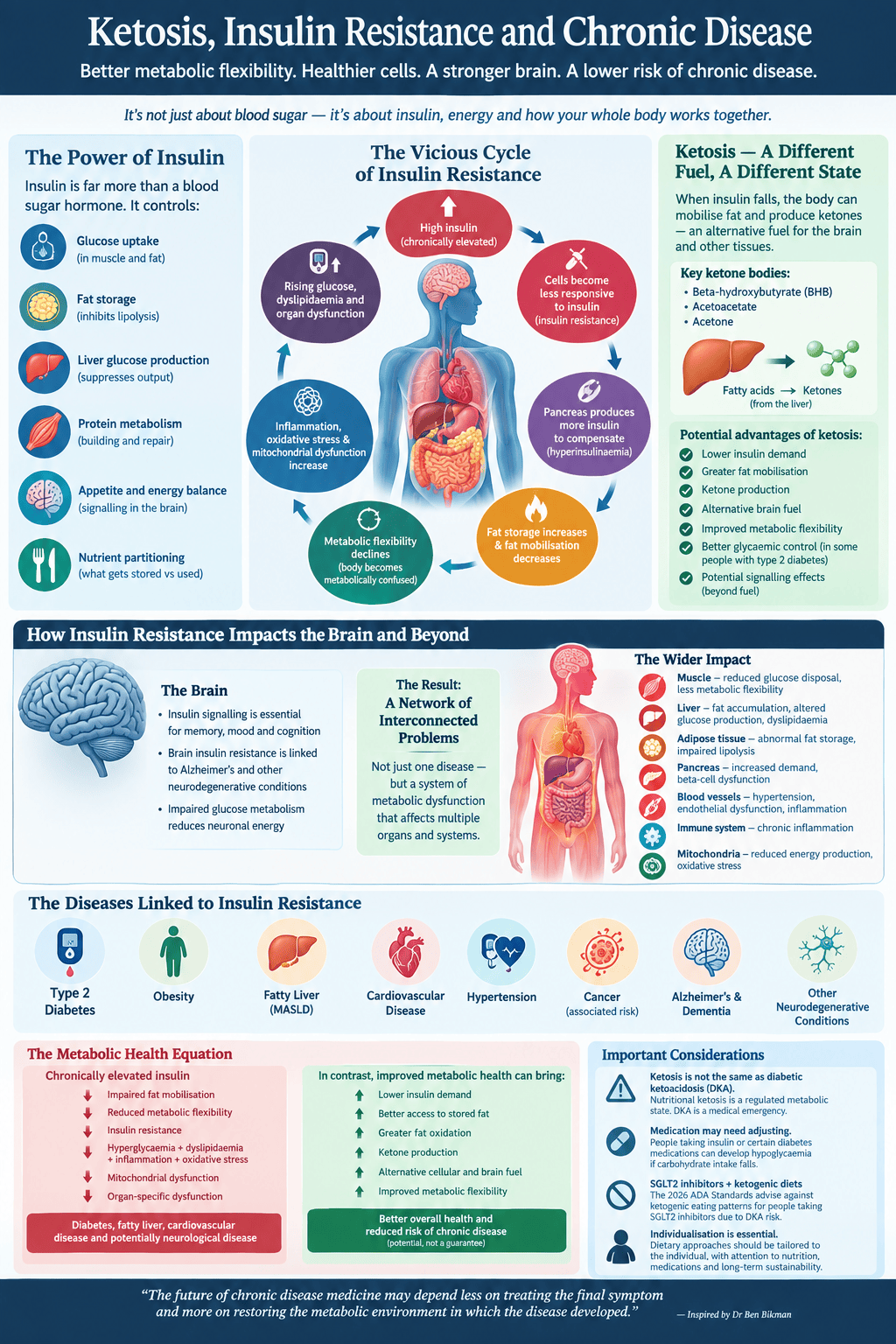
Among its many actions, insulin:
- promotes glucose uptake in insulin-sensitive tissues;
- suppresses hepatic glucose production;
- inhibits lipolysis;
- promotes energy storage;
- influences protein metabolism;
- stimulates anabolic signalling;
- regulates nutrient partitioning;
- influences appetite and energy balance;
- participates in signalling within the brain.
In other words, insulin is partly a metabolic traffic controller.
When insulin rises appropriately after a meal, this is normal physiology.
The problem arises when the system is chronically pushed toward a high-insulin state and cells progressively become less responsive to insulin.
The pancreas can initially compensate by producing more.
This produces a vicious cycle:
reduced insulin sensitivity → higher insulin secretion → continued metabolic pressure → worsening insulin resistance → further compensatory insulin secretion.
Eventually the pancreas may no longer be able to compensate adequately and blood glucose begins to rise.
By the time glucose becomes diagnostic for type 2 diabetes, substantial metabolic dysfunction may already have been present for years.
This is why insulin resistance deserves attention independently of glucose.
The scientific literature identifies insulin resistance as a central feature of type 2 diabetes and associates it with hyperglycaemia, abnormal blood lipids, inflammation, oxidative stress and atherosclerosis.
2. The homeostasis problem: when the metabolic switch gets stuck
Human metabolism is designed to move between different physiological states.
After eating, insulin rises and the body preferentially uses and stores incoming nutrients.
Between meals, insulin falls. The body increasingly accesses stored energy.
During prolonged fasting or carbohydrate restriction, insulin can fall sufficiently for lipolysis and hepatic ketogenesis to increase.
This ability to move between fuel sources is sometimes described as metabolic flexibility.
Insulin resistance disrupts this flexibility.
The body can become metabolically confused: energy is abundant, yet individual tissues may have difficulty accessing or appropriately responding to that energy.
This creates a fascinating paradox.
A person can have plenty of glucose circulating in the blood while cells are simultaneously becoming less responsive to insulin’s signal.
And this problem does not necessarily remain confined to muscle and liver.
The brain has its own insulin signalling system.
3. The brain is an insulin-sensitive organ
The idea that insulin matters to the brain is particularly important.
Insulin receptors are widely distributed throughout the central nervous system. Brain insulin signalling participates in energy homeostasis, nutrient partitioning, appetite regulation and other neurological functions.
Research has also demonstrated effects on neuronal survival, synaptic function, neurotransmitter turnover and other aspects of brain physiology.
This changes the way we should think about insulin.
It is not simply:
food → pancreas → insulin → muscle.
There is also:
food → insulin → brain signalling → metabolic regulation.
When brain cells become insulin resistant, insulin signalling can become impaired.
Research reviews describe brain insulin resistance as a failure of brain cells to respond normally to insulin, with potential consequences for synaptic, metabolic and immune functions.
And this brings us to Alzheimer’s disease.
4. Alzheimer’s disease and the concept of brain insulin resistance
Alzheimer’s disease is extraordinarily complex.
There is no single cause, and no responsible scientific account should reduce Alzheimer’s to simply “too much sugar” or “too much insulin.”
However, one increasingly investigated feature of Alzheimer’s is impaired brain insulin signalling.
Type 2 diabetes is associated with a substantially increased risk of dementia, while research has identified insulin resistance within the brains of people with Alzheimer’s disease.
Why might this matter?
The brain requires enormous amounts of energy.
Neurons need continuous ATP production to maintain membrane potentials, communicate with other neurons, regulate neurotransmitters and maintain cellular integrity.
Glucose is normally an important brain fuel.
But insulin resistance can interfere with aspects of glucose metabolism and signalling.
The result is potentially profound:
the body can have plenty of fuel available while the brain becomes increasingly inefficient at using one of its principal fuels.
Research has identified reduced cerebral glucose metabolism in Alzheimer’s disease, alongside abnormalities in insulin signalling, mitochondrial function, inflammation and other processes.
5. The remarkable role of ketones in the brain
This is where ketosis becomes particularly interesting.
The brain cannot simply burn large quantities of circulating fatty acids directly for energy in the way many peripheral tissues can.
However, the liver can convert fatty acids into ketone bodies:
- beta-hydroxybutyrate;
- acetoacetate;
- acetone.
These ketones can cross the blood-brain barrier and be used by neurons and other brain cells as an alternative energy substrate.
Crucially, ketone utilisation does not depend on the same insulin-mediated glucose pathway.
This creates a fascinating metabolic possibility.
If an ageing or metabolically impaired brain becomes less efficient at using glucose, ketones may provide an alternative source of energy.
Research supports the existence of impaired glucose metabolism in Alzheimer’s while ketone metabolism can remain comparatively preserved, particularly in earlier stages.
This is one reason ketogenic diets and exogenous ketones are being investigated as potential adjunctive approaches to neurological disorders.
It is important, however, to distinguish metabolic rescue from disease reversal.
Providing an alternative fuel may improve energy availability and potentially cognitive function in some circumstances, but this does not establish that ketosis cures Alzheimer’s disease.
6. Why Dr. Bikman places such emphasis on insulin
Dr. Ben Bikman’s metabolic framework is particularly relevant here.
His argument is not simply that ketones are “good.”
Rather, he places enormous emphasis on the relationship between insulin and ketone production.
Insulin suppresses lipolysis and ketogenesis.
When insulin is chronically elevated, the body’s ability to mobilise stored fat and produce ketones is suppressed.
When insulin falls, fat mobilisation and ketogenesis become increasingly available.
Thus:
high insulin → energy storage → reduced fat mobilisation → reduced ketogenesis
whereas:
low insulin → increased fat mobilisation → increased hepatic ketogenesis → greater ketone availability.
Bikman has described ketones as a marker of the metabolic state created when insulin is sufficiently low to permit substantial fat oxidation.
This is an important conceptual distinction.
The potential benefit of a ketogenic diet may not simply be “having ketones.”
It may be the combination of:
lower insulin + reduced glucose exposure + increased fat mobilisation + ketone production + improved metabolic flexibility.
Bikman himself has argued that much of the benefit of carbohydrate restriction may arise from controlling insulin, with ketones providing additional effects.
7. Type 2 diabetes: breaking the insulin-resistance cycle
Type 2 diabetes provides perhaps the clearest example of this metabolic model.
A typical progression can look like this:
Excess energy intake / metabolic stress
↓
Insulin resistance
↓
Higher insulin secretion
↓
Greater difficulty accessing stored fat
↓
Increasing metabolic dysfunction
↓
Rising glucose
↓
Type 2 diabetes
A ketogenic or very-low-carbohydrate approach can attack several parts of this cycle simultaneously.
Reducing carbohydrate intake can substantially reduce the amount of glucose entering the bloodstream after meals.
Lower carbohydrate availability can reduce insulin demand.
Lower insulin facilitates lipolysis and ketogenesis.
Weight loss, when it occurs, can further improve insulin sensitivity.
The result can be a substantial improvement in glycaemic control for some people with type 2 diabetes.
There is clinical evidence supporting carbohydrate restriction as one viable dietary approach for diabetes management, although the magnitude and durability of benefit varies between individuals and studies. The 2026 American Diabetes Association Standards of Care state that reducing carbohydrate intake can improve glycaemia for some adults with diabetes, while also emphasising individualisation and nutritional quality.
The ADA also notes that very-low-carbohydrate diets can improve HbA1c in the short term, although longer-term results are less consistently different from other dietary approaches.
Therefore, ketosis should not be presented as the only successful treatment for type 2 diabetes.
But it is a legitimate metabolic strategy worthy of consideration.
8. The liver: insulin resistance and fatty liver
The liver is another major target of insulin.
Insulin normally coordinates nutrient storage and suppresses excessive glucose production.
When hepatic insulin resistance develops, the liver can simultaneously become resistant to insulin’s glucose-regulating effects while retaining certain lipogenic responses.
The consequence can be increased hepatic fat accumulation.
This helps explain the close relationship between:
insulin resistance → hyperinsulinaemia → dyslipidaemia → fatty liver → worsening metabolic dysfunction.
Non-alcoholic fatty liver disease—now increasingly termed metabolic dysfunction-associated steatotic liver disease (MASLD)—is strongly associated with obesity, insulin resistance and type 2 diabetes.
Reducing excessive energy intake, improving insulin sensitivity and losing excess body fat can substantially improve liver fat.
This is another area where the insulin-centred model provides a useful framework.
9. Cardiovascular disease: the metabolic web
Cardiovascular disease cannot responsibly be attributed to insulin alone.
Blood pressure, LDL cholesterol, lipoprotein particle number, smoking, inflammation, genetics, kidney function, physical activity and many other variables matter.
Nevertheless, insulin resistance is deeply intertwined with cardiovascular risk.
Insulin resistance is associated with:
- hypertension;
- abnormal triglycerides;
- reduced HDL cholesterol;
- visceral adiposity;
- inflammation;
- endothelial dysfunction;
- oxidative stress;
- fatty liver;
- type 2 diabetes.
The important point is that these may not be independent diseases.
They can be different manifestations of a common metabolic environment.
Instead of viewing every abnormality separately, insulin resistance encourages us to ask:
What biological system is producing all of these abnormalities simultaneously?
10. Inflammation and oxidative stress
Chronic metabolic dysfunction also creates an inflammatory environment.
Insulin resistance is associated with oxidative stress and inflammatory signalling.
This matters because chronic inflammation can affect virtually every major organ system.
The brain is particularly vulnerable.
Neurons have enormous energy requirements, while the brain contains large quantities of highly metabolically active membranes and lipids.
Mitochondria must continuously produce energy.
Oxidative stress can damage proteins, lipids and DNA.
Inflammatory signalling can alter neuronal function.
And impaired mitochondrial function can further compromise cellular energy production.
Thus, insulin resistance potentially creates a self-reinforcing biological environment:
insulin resistance → metabolic dysfunction → oxidative stress → inflammation → mitochondrial dysfunction → impaired cellular metabolism → further metabolic dysfunction.
This is one reason metabolic disease can become systemic rather than remaining a problem of blood sugar alone.
11. Ketones are more than fuel
One of the most interesting developments in metabolic science is the recognition that ketones are not merely an emergency fuel.
Beta-hydroxybutyrate, in particular, can act as a signalling molecule as well as an energy substrate.
Ketones influence mitochondrial metabolism and cellular signalling pathways.
Research into ketone biology is examining effects involving oxidative stress, inflammation, gene expression and cellular adaptation.
This creates an important distinction:
glucose and ketones are not simply interchangeable calories.
They interact differently with cellular metabolism.
Dr. Bikman’s work has particularly emphasised the ability of ketones to alter mitochondrial energy metabolism.
That does not mean that glucose is harmful.
Glucose is an essential metabolic substrate and the body has sophisticated mechanisms for producing it when dietary carbohydrate is low.
The question is whether the modern metabolic environment keeps us excessively dependent on glucose while simultaneously impairing our ability to efficiently access fat and ketones.
12. What about dementia beyond Alzheimer’s?
Alzheimer’s is not the only neurological condition in which energy metabolism is being investigated.
Research has explored ketogenic metabolism in conditions including:
- epilepsy;
- traumatic brain injury;
- Parkinson’s disease;
- migraines;
- cognitive impairment;
- neurodegenerative disorders.
The strength of evidence varies considerably between these conditions.
The strongest established therapeutic application of ketogenic diets in neurology is drug-resistant epilepsy, particularly in certain forms of childhood epilepsy.
For other neurological disorders, the evidence is promising but substantially less definitive.
The biological rationale is nevertheless compelling.
Many neurological disorders involve some combination of:
mitochondrial dysfunction + oxidative stress + inflammation + impaired glucose metabolism + altered neuronal energy requirements.
Ketones may provide an alternative metabolic substrate while also influencing signalling pathways.
That is an area of active research—not a licence to claim that ketosis cures neurological disease.
13. The brain’s metabolic paradox
Perhaps the most striking way to understand this entire subject is through a paradox.
Imagine a person whose bloodstream contains abundant glucose.
Yet inside the brain, certain regions may have declining glucose metabolism.
The body is not necessarily short of energy.
Rather, the problem may partly involve the ability of particular cells to access and process that energy efficiently.
Ketones potentially provide a bypass.
They offer the brain another fuel.
This is one reason researchers have investigated ketogenic diets and exogenous ketones in Alzheimer’s disease.
Some early studies and case reports have reported improvements in aspects of cognition or function during periods of increased ketone availability, but these findings do not establish that ketosis reverses neurodegeneration. Larger and longer clinical trials are still required.
The distinction is crucial:
Ketones may improve brain energy availability without necessarily removing the underlying pathology.
14. Insulin resistance as a systems problem
One of the most useful lessons from metabolic science is that chronic disease rarely respects the boundaries of medical specialties.
Consider what insulin resistance can potentially influence:
Muscle
Reduced glucose disposal and impaired metabolic flexibility.
Liver
Fat accumulation, altered glucose production and dyslipidaemia.
Adipose tissue
Abnormal fat storage and impaired regulation of lipolysis.
Pancreas
Increasing demand on beta cells and eventual beta-cell dysfunction.
Blood vessels
Endothelial dysfunction and cardiovascular risk.
Brain
Impaired insulin signalling, altered glucose metabolism and potentially impaired neuronal function.
Immune system
Altered inflammatory signalling.
Mitochondria
Changes in energy production and oxidative stress.
The result is not one disease.
It is a network of interconnected metabolic abnormalities.
That may explain why improving insulin sensitivity can have effects across multiple organ systems simultaneously.
15. Why ketosis may be particularly interesting
Ketosis is essentially a metabolic state in which ketone production rises because the body is relying more heavily on fat as an energy source.
It can occur through:
- carbohydrate restriction;
- fasting;
- prolonged exercise;
- certain therapeutic dietary protocols.
A ketogenic diet deliberately creates a sustained nutritional environment conducive to ketone production.
The potential advantages include:
1. Lower insulin demand
Less dietary carbohydrate generally means less insulin is required to manage post-meal glucose.
2. Greater fat mobilisation
Lower insulin permits greater access to stored fat.
3. Ketone production
The liver converts fatty acids into ketones that can be used by the brain and other tissues.
4. An alternative brain fuel
Ketones can provide energy when glucose metabolism is impaired or when glucose availability is reduced.
5. Improved metabolic flexibility
The body becomes more capable of switching between carbohydrate and fat-derived fuels.
6. Potential improvement in glycaemic control
This is particularly relevant to insulin-resistant type 2 diabetes.
7. Potential reduction in appetite for some individuals
Ketogenic diets can alter hunger and satiety, although responses vary considerably.
8. Potential signalling effects
Ketones may influence cellular pathways beyond their role as fuel.
16. But ketosis is not automatically healthy
This point deserves emphasis.
“Ketosis” and “diabetic ketoacidosis” are not the same physiological state.
Nutritional ketosis is a regulated metabolic state.
Diabetic ketoacidosis (DKA) is a potentially life-threatening metabolic emergency characterised by severe insulin deficiency and excessive ketone accumulation, usually accompanied by metabolic acidosis.
People with diabetes—particularly those taking insulin or certain medications—must not assume that ketogenic eating is automatically safe.
The 2026 ADA Standards specifically caution that people taking SGLT2 inhibitors should avoid ketogenic eating patterns because of the risk of ketoacidosis.
Medication requirements can also change rapidly when carbohydrate intake falls.
Someone taking insulin or insulin-secretagogue medications can develop hypoglycaemia if medication is not appropriately adjusted.
Therefore:
ketosis is a physiological tool, not a treatment that should be applied blindly.
17. The bigger question: are we treating the symptom or the system?
Perhaps the most important implication of the insulin-resistance hypothesis is philosophical.
Modern medicine often divides disease into categories:
- diabetes;
- obesity;
- cardiovascular disease;
- fatty liver;
- hypertension;
- dementia;
- neurodegeneration.
But biology does not necessarily operate in categories.
A person may simultaneously have insulin resistance, visceral obesity, hypertension, fatty liver, dyslipidaemia and cognitive decline.
These conditions may interact.
Improving metabolic health therefore has the potential to influence several problems at once.
That does not mean insulin resistance explains everything.
It does mean it deserves to be taken seriously as one of the major biological hubs connecting modern chronic diseases.
18. The metabolic health equation
The emerging picture can be simplified into a useful conceptual model:
Chronically elevated insulin
↓
Impaired fat mobilisation
↓
Reduced metabolic flexibility
↓
Insulin resistance
↓
Hyperglycaemia + dyslipidaemia + inflammation + oxidative stress
↓
Mitochondrial dysfunction
↓
Organ-specific metabolic dysfunction
↓
Diabetes, fatty liver, cardiovascular disease and potentially neurological disease
Conversely:
Lower insulin demand
↓
Improved access to stored fat
↓
Greater fat oxidation
↓
Ketone production
↓
Alternative cellular and brain fuel
↓
Potential improvement in metabolic flexibility
The important word is potential.
Human biology is more complicated than a single pathway.
19. What the evidence actually supports
A scientifically responsible conclusion is more nuanced than either extreme.
It would be incorrect to say:
“Insulin causes all chronic disease and ketosis cures it.”
The evidence does not support that statement.
It would also be incorrect to say:
“Insulin resistance only matters once someone develops diabetes.”
Evidence increasingly shows that insulin resistance is involved much earlier in the development of metabolic disease.
The strongest conclusions at present are that:
- insulin is a major regulator of whole-body energy metabolism;
- insulin resistance is central to type 2 diabetes;
- insulin resistance is associated with obesity, dyslipidaemia, inflammation, oxidative stress and cardiovascular disease;
- brain insulin signalling is biologically important;
- brain insulin resistance is associated with Alzheimer’s disease and other metabolic abnormalities;
- Alzheimer’s disease involves impaired cerebral glucose metabolism;
- ketones can provide an alternative fuel for the brain;
- ketogenic diets can improve glycaemic control in some people with type 2 diabetes;
- ketogenic therapy is an established treatment option for certain forms of drug-resistant epilepsy;
- ketogenic approaches for Alzheimer’s and other neurodegenerative diseases remain investigational;
- long-term outcomes vary between individuals;
- diet quality, nutritional adequacy and sustainability remain important;
- ketogenic diets can be inappropriate or dangerous in certain medical circumstances.
The 2026 ADA Standards therefore take a pragmatic position: carbohydrate reduction can be considered for some adults with diabetes, but dietary approaches should be individualised and nutritionally adequate.
20. The future of metabolic medicine
Perhaps the most exciting possibility is that medicine is gradually moving from a glucose-centric model toward a broader understanding of metabolic health.
Instead of asking only:
“What is your blood glucose?”
we may increasingly ask:
“How does your body respond to insulin?”
“Can you efficiently switch between fuel sources?”
“What is happening to your liver fat?”
“How metabolically healthy is your brain?”
“Can your mitochondria efficiently produce energy?”
“Are you metabolically flexible?”
And perhaps most importantly:
“What is driving the disease process before the disease becomes clinically obvious?”
This is where the work of researchers such as Ben Bikman becomes particularly interesting.
His central emphasis on insulin resistance provides a framework for looking at chronic disease as a problem of metabolic regulation rather than simply a collection of isolated symptoms.
Ketosis then becomes more than a diet trend.
It becomes a window into a different physiological state—one characterised by lower insulin signalling, increased fat oxidation and increased availability of ketones.
Whether that state will ultimately prove to be a major therapeutic tool across diabetes, neurodegeneration, cardiovascular disease and other chronic illnesses remains an active scientific question.
But the underlying question is already changing:
Perhaps the future of chronic disease medicine will depend less on treating the final symptom and more on restoring the metabolic environment in which the disease developed.
And at the centre of that environment may be one of the body’s oldest and most powerful hormones:
insulin.
In order to address this a ketogenic diet is advisable, preferably Organic and potentially Carnivore, however whichever diet you choose a useful addition is intermittent fasting and products which aid in balancing insulin as recommended by Dr. Ben Bikman.


Leave a Reply